
Shotguns, cottages, ranches and raised homes
Spray Foam Insulation in New Orleans, LA
Insulation planned for how New Orleans houses are actually built: raised floors, hot attics and old walls.
- Free on-site estimates
- Itemized written quotes with material, depth and R-value
- Under-floor, attic and moisture problems checked first
Built for the Heat, the Damp and the Old Houses
Spray foam insulation in New Orleans has to handle a long, sticky cooling season and a housing stock unlike any other American city. Wikipedia's airport normals show about 63 inches of rain a year and fewer than eight nights a year with a freeze, and the airport set a record high of 105F on August 27, 2023. Air conditioning runs most of the year, and humid air pushes into any gap it can find. We are spray foam insulation contractors who seal those gaps and insulate the attic, the floor and the walls with whatever material fits each space best.
How New Orleans houses lose comfort
Wikipedia names shotgun houses, bungalows and Creole cottages among the city's signature styles. Many of them sit a few feet off the ground on brick piers, with air moving freely under the floor. They have tall ceilings, thin or empty walls, and attics that were never meant to be insulated. Post-war ranches in the suburbs have the opposite problem: the floor is a slab, but the air handler and ducts sit in an attic that bakes above 130F in summer. Homes raised high after 2005 have an entire floor exposed to the outside on the underside. Each needs a different plan, and the plan starts with looking.
What the code asks
Louisiana uses the 2021 International Residential Code and treats the whole state as climate zone 2 for energy. The Insulation Institute's summary lists R-38 for ceilings and R-13 for wood-frame walls. For existing homes, the Department of Energy suggests R-49 to R-60 in an uninsulated zone 2 attic, R-38 to R-49 more on top of 3 to 4 inches, and R-13 for an uninsulated floor. Many older New Orleans homes have far less, and some have nothing at all in the floor or walls.
Closed cell vs open cell
HomeGuide lists open-cell foam at about R-3.5 to R-3.7 per inch and closed-cell at about R-5 to R-7. Open-cell is soft, expands a lot and is the usual pick under roof decks to seal an attic. Closed-cell is dense, slows vapor and does not soak up water, so it is the pick for the underside of raised floors, the lower parts of walls and anywhere flood water could reach. On a raised house, closed-cell foam under the floor seals the drafts coming up through the boards and keeps the framing from collecting moisture.
Low ground and storm history
A 2016 study cited on Wikipedia found about 65% of New Orleans at or below mean sea level, and Katrina flooded more than 80% of the city in 2005. Insulation that has been soaked loses most of its value and holds water against wood. If your house took on water or had a roof leak in a hurricane, we check for wet or missing insulation in the floor, the lower walls and the attic, and replace what needs it.
Termites
LSU AgCenter calls the Formosan termite the most destructive insect in Louisiana, and the New Orleans area is in the heart of its range. Foam can hide termite tubes, so we leave inspection strips open on pier caps and foundation edges and suggest you tell your pest control company about any foam work under the house.
Spray foam insulation cost
HomeGuide's 2026 guide puts installed spray foam at $1.50 to $5.00 per square foot: about $1.50 to $3.50 for open-cell and $3.00 to $5.00 for closed-cell. About 1,000 square feet costs $1,500 to $5,000, and many spray foam insulation companies have a job minimum of $1,000 to $2,000 or more. Fixr lists foam in existing walls at $3.15 to $7.50 per square foot. These are national ranges; access, thickness, prep and removal of old material set your price, and what you pay is the number on the written estimate.
Choosing insulation contractors
When you call insulation contractors or search for spray foam insulation near me, ask each one the same things. What will you seal first? Which foam goes where, at what thickness and R-value? How will you handle the vents if you seal the attic? What about the space under the floor? How long should we stay out after spraying? HomeGuide's guidance is at least 24 hours. We answer every one of those in writing.
Energy Smart
Entergy's Energy Smart program in New Orleans offers home energy assessments, and its page says assessed homeowners can get instant discounts or free weatherization on recommended follow-up work, with extra help for income-eligible households at or below 80% of area median income. Check the current rules with Energy Smart before you book.
Our Insulation Services
Six services for New Orleans houses, from the attic down to the space under the floor.
Spray Foam Insulation
Open-cell and closed-cell foam for roof decks, raised floors and walls, each picked for the space it goes in.
Learn more →Attic Encapsulation
Foam on the roof deck and gables to seal the attic, so ducts and the air handler sit in mild air instead of 130-degree heat.
Learn more →Raised Floor & Crawl Space Insulation
Insulating and sealing the floors of houses on piers and the crawl spaces under raised homes.
Learn more →Wall Insulation for Older Homes
Dense-pack and foam for shotgun, cottage and bungalow walls that were built with nothing in them.
Learn more →Blown-In Insulation
Cellulose or fiberglass blown into attic floors and walls, the lower-cost way to add depth.
Learn more →Storm-Damaged Insulation Removal
Removing insulation soaked by floods or roof leaks, or fouled by pests, then sealing and reinsulating.
Learn more →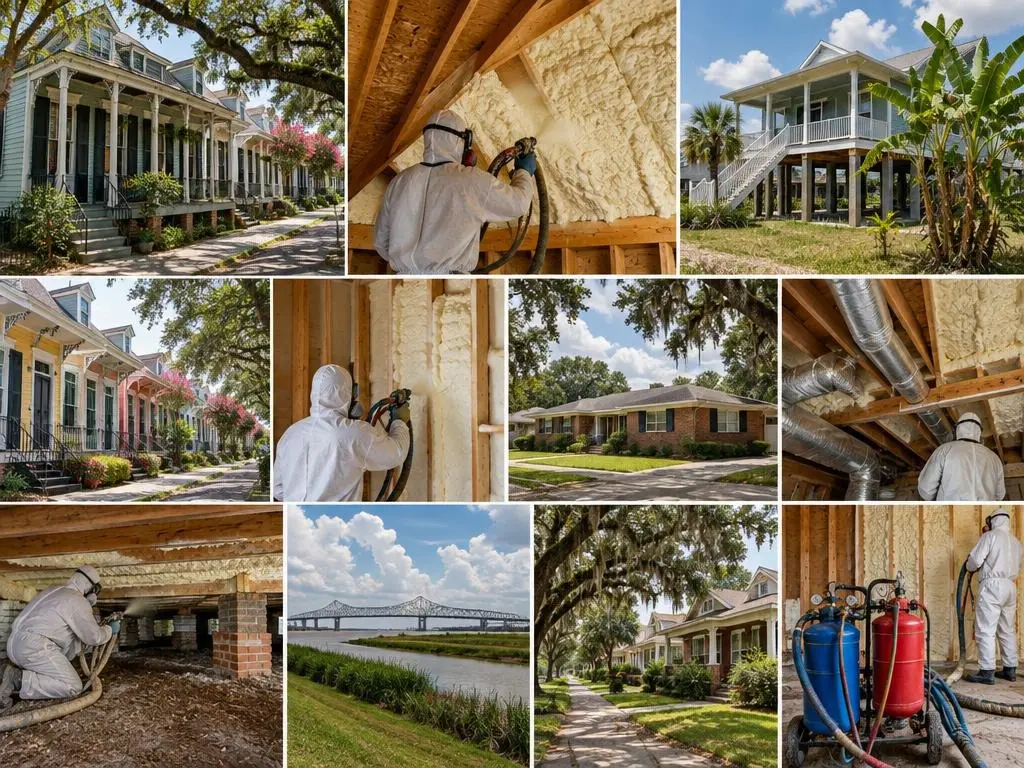
Why Homeowners Call New Orleans Spray Foam Insulation
We look first
Quotes come after we have seen the attic, the space under the house and the walls.
Old houses, handled carefully
We work from the attic and below the floor so finished rooms are left alone where possible.
Material matched to the space
Closed-cell where water could reach, open-cell under roofs, loose fill where it pays.
Itemized quotes
Each area lists material, thickness or depth, R-value and price.
Neighborhoods and Towns We Serve
We work across New Orleans and the suburbs: Metairie, Kenner, Harahan, River Ridge and Jefferson on the east bank of Jefferson Parish; Gretna, Terrytown, Harvey, Marrero and Westwego on the West Bank; Belle Chasse in Plaquemines; Chalmette and Arabi in St. Bernard; Destrehan in St. Charles; and Slidell across the lake. Older parts of the city and the river towns have more raised homes on piers with open space under the floor. The suburbs built in the 1950s through the 1970s are mostly slab ranches with ducts in hot attics. Areas rebuilt after 2005 have more homes raised high, with a whole floor exposed underneath.
- Spray Foam Insulation in New Orleans, LA
- Spray Foam Insulation in Metairie, LA
- Spray Foam Insulation in Kenner, LA
- Spray Foam Insulation in Harahan, LA
- Spray Foam Insulation in River Ridge, LA
- Spray Foam Insulation in Jefferson, LA
- Spray Foam Insulation in Gretna, LA
- Spray Foam Insulation in Terrytown, LA
- Spray Foam Insulation in Harvey, LA
- Spray Foam Insulation in Marrero, LA
- Spray Foam Insulation in Westwego, LA
- Spray Foam Insulation in Belle Chasse, LA
- Spray Foam Insulation in Chalmette, LA
- Spray Foam Insulation in Arabi, LA
- Spray Foam Insulation in Slidell, LA
- Spray Foam Insulation in Destrehan, LA

Common Questions
How much does spray foam insulation cost in New Orleans?
National guides put installed foam at $1.50 to $5.00 per square foot (HomeGuide). Open-cell is at the low end, closed-cell at the high end. A raised-floor job or an attic roof deck often lands in the low thousands. We give you a written price after a visit.
What are the pros and cons of spray foam insulation?
It seals air and insulates in one step, does not settle, and closed-cell resists water. It costs more than loose fill, it is hard to remove, and it can hide leaks or termite activity if those are not handled first.
Can mold grow behind spray foam insulation?
Foam is not food for mold, but if a roof or plumbing leak wets the wood behind it, the wood can still rot or grow mold. That is why we check for leaks first and why sealed attics need humidity under control.
Should I insulate under my raised house?
Usually yes. The DOE suggests R-13 for an uninsulated floor in zone 2. Closed-cell foam under the subfloor seals drafts and does not soak up water if the area floods.
What R-value does a New Orleans attic need?
Louisiana's code summary lists R-38 for ceilings in new homes. The DOE suggests R-49 to R-60 for an uninsulated zone 2 attic, or adding R-38 to R-49 over 3 to 4 inches.
Does Energy Smart help pay for insulation?
Entergy's Energy Smart page describes home assessments with instant discounts or free weatherization on recommended follow-up work. Check current rules and amounts with the program.
Get a Spray Foam Insulation Estimate
Tell us about your house. We will come look, explain what we find and send a written price.